
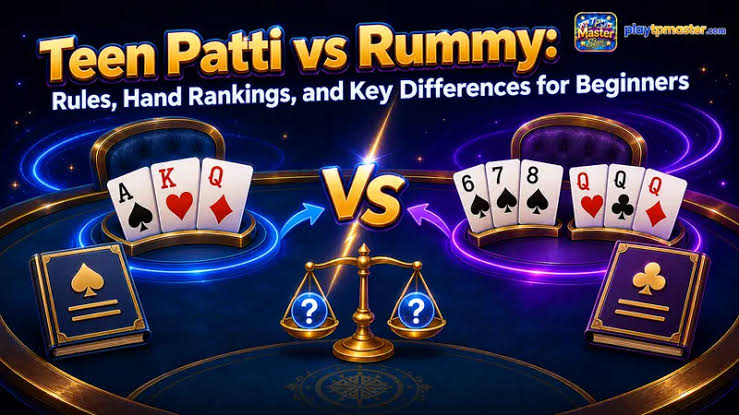
Card games have been a popular source of entertainment for many years. With the growth of smartphones and online gaming platforms, traditional games such as Teen Patti and Rummy have become easier to explore. Both games offer different styles of gameplay and require players to understand specific rules, card combinations, and winning conditions.
Teen Patti is mainly based on comparing three-card hands, whereas Rummy focuses on arranging cards into valid sequences and sets. Beginners who understand these differences can learn the games more easily. This guide explains Teen Patti and Rummy rules, practical examples, useful tips, and frequently asked questions in simple language.
Understanding Teen Patti
Teen Patti Master is a traditional card game commonly played in South Asia. It generally uses a standard 52-card deck without jokers. Each player receives three cards, and the objective is to have the strongest possible hand according to the standard ranking system.
Depending on the variation, the game may include betting rounds. Players can decide whether to continue playing or fold their cards. Different online platforms may introduce additional formats, so checking the instructions before starting is important.
Teen Patti Hand Rankings
Learning the card rankings is essential for understanding Teen Patti. The standard rankings from strongest to weakest are:
- Trail (Three of a Kind): Three cards of the same rank, such as three Aces.
- Pure Sequence: Three consecutive cards of the same suit, such as 4, 5, and 6 of hearts.
- Sequence: Three consecutive cards belonging to different suits.
- Color: Three cards of the same suit that do not form a sequence.
- Pair: Two cards with the same rank, such as two Kings.
- High Card: The highest individual card when no stronger combination is formed.
For example, a player holding three Queens has a Trail, while another player holding 7, 8, and 9 of diamonds has a Pure Sequence. Under standard rankings, the Trail is stronger.
Understanding these rankings helps beginners compare different hands and follow the game correctly.
Understanding Rummy Rules
Rummy is another popular card game that requires players to arrange cards into valid combinations. Unlike Teen Patti, which focuses on three-card hands, Rummy involves drawing, discarding, and organizing a larger collection of cards.
One common variation is 13-card Rummy. Each player receives 13 cards and tries to create valid sequences and sets. During each turn, a player draws a card from the available pile and discards an unwanted card.
The objective is to complete the required combinations and make a valid declaration.
Main Rummy Combinations
1. Pure Sequence
A pure sequence consists of at least three consecutive cards of the same suit without using a joker.
Example: 3, 4, and 5 of hearts.
2. Impure Sequence
An impure sequence contains consecutive cards of the same suit and uses a joker to replace a missing card.
Example: 6 and 8 of diamonds with a joker representing 7 of diamonds.
3. Set
A set consists of three or four cards of the same rank but different suits.
Example: 9 of hearts, 9 of clubs, and 9 of spades.
In standard 13-card Rummy, a valid declaration generally requires at least two sequences, including one pure sequence.
Practical Examples of Teen Patti and Rummy
Practical examples make it easier to understand how each game works.
Teen Patti Example:
Imagine three players receive the following cards:
- Player A receives three Kings.
- Player B receives 5, 6, and 7 of hearts.
- Player C receives two Queens and a 10.
Player A has a Trail, Player B has a Pure Sequence, and Player C has a Pair. According to standard Teen Patti rankings, Player A has the strongest hand.
Rummy Example:
Suppose a player receives these cards:
- 4, 5, and 6 of hearts.
- 7, 8, and 9 of clubs.
- Three Queens of different suits.
- Four additional cards that still need arranging.
The player already has two sequences and one set. The remaining cards must be arranged into valid combinations before making a declaration.
These examples highlight the main difference between the two games: Teen Patti compares hand strength, while Rummy focuses on creating valid card arrangements.
Important Tips for Beginners
If you are learning these games for the first time, a few simple practices can make the experience easier.
Learn the Rules Carefully: Start by understanding basic hand rankings in Teen Patti and combination requirements in Rummy.
Practice with Examples: Use sample cards to identify Trails, Pairs, Pure Sequences, and Sets.
Understand Different Variations: Some platforms may offer special game modes with additional rules. Read the instructions before participating.
Pay Attention to Cards: In Rummy, observe the cards you draw and discard. In Teen Patti, understand the rules for betting and folding.
Protect Your Account: Use strong passwords and avoid sharing login details or verification codes.
Set Personal Limits: If a platform offers real-money gaming, understand the financial risks, follow local laws, and never spend money you cannot afford to lose.
Remember that card games involve uncertainty. No strategy or playing technique can guarantee a winning result.
Common Questions About Teen Patti and Rummy
1. What is the main objective of Teen Patti?
The main objective is to have the strongest three-card hand according to the game’s ranking system.
2. How many cards are used in Teen Patti?
Each player generally receives three cards from a standard 52-card deck.
3. What is a pure sequence in Rummy?
A pure sequence is a group of at least three consecutive cards belonging to the same suit without using a joker.
4. How many cards are dealt in 13-card Rummy?
Each player receives 13 cards in the standard 13-card variation.
5. Can jokers be used in Rummy?
Yes. Jokers can generally replace missing cards in impure sequences and sets, according to the applicable game rules. They cannot be used in a pure sequence.
6. Are Teen Patti and Rummy the same game?
No. Teen Patti involves comparing three-card hands, while Rummy focuses on arranging cards into valid sequences and sets.
7. Can beginners learn both games?
Yes. Beginners can start with basic instructions, learn common combinations, and gradually understand different game formats.
Conclusion
Teen Patti and Rummy are two popular card games with different rules and playing styles. Teen Patti focuses on three-card hand rankings, while Rummy requires players to organize cards into valid sequences and sets.
Understanding the basic rules, practicing practical examples, and reviewing common questions can help beginners become familiar with both games. Whether you are exploring traditional card games or learning about online gaming platforms, always check the applicable rules, protect your personal information, and make responsible entertainment choices.